One Cat, Three Conditions: Merry’s Story
When Merry came to see me last summer at the age of 15, she had been a very healthy girl all her life. Neither her owner nor I could have imagined how complicated life was about to become over the next few months.
Merry had been hungrier and thirstier than usual in the previous few months, and her coat was looking unkempt. On examination, the main findings were that she had an unusually fast heart rate, and I could feel a small nodule in her neck. These signs made me suspicious that she had an overactive thyroid, which is fairly common in older cats.
I took a blood sample to check her thyroid level, liver and kidney function, glucose level, and blood cell counts. The results confirmed that she was hyperthyroid and had a mild degree of kidney dysfunction, so we started her on medication to reduce her thyroid level.
When she came for a check-up a few weeks later, she was still drinking a lot and had lost more weight despite taking her medication well. I was concerned that something else might also be going on, so I repeated her blood tests. This time, the results showed that her thyroid level was well controlled, but her glucose had risen to a very high level, indicating that she had also developed diabetes.
Although there is now an oral liquid medication that can be used in some feline diabetics, this was not suitable for Merry, so she was started on twice-daily insulin injections to be given at home.
Her owner was used to giving injections, and she and Merry coped very well with this regime. With a newly diagnosed diabetic, it is important to start at a low dose and increase gradually depending on response. Blood tests showed that Merry was responding to the insulin, but we were struggling to achieve the level of control I would expect in a diabetic patient. She was still losing weight, and her drinking had increased even further.
At her next review, I sent a urine sample away for laboratory testing rather than just testing it in-house, and the next piece of Merry’s jigsaw was revealed. She had started to lose protein in her urine at a rate indicating a rare complication of diabetes in cats: a kidney condition called diabetic glomerulonephropathy. This explained why she was still drinking so much water and represented a third condition to be managed rather than cured. I prescribed medication to try to reduce the protein loss through the kidneys.
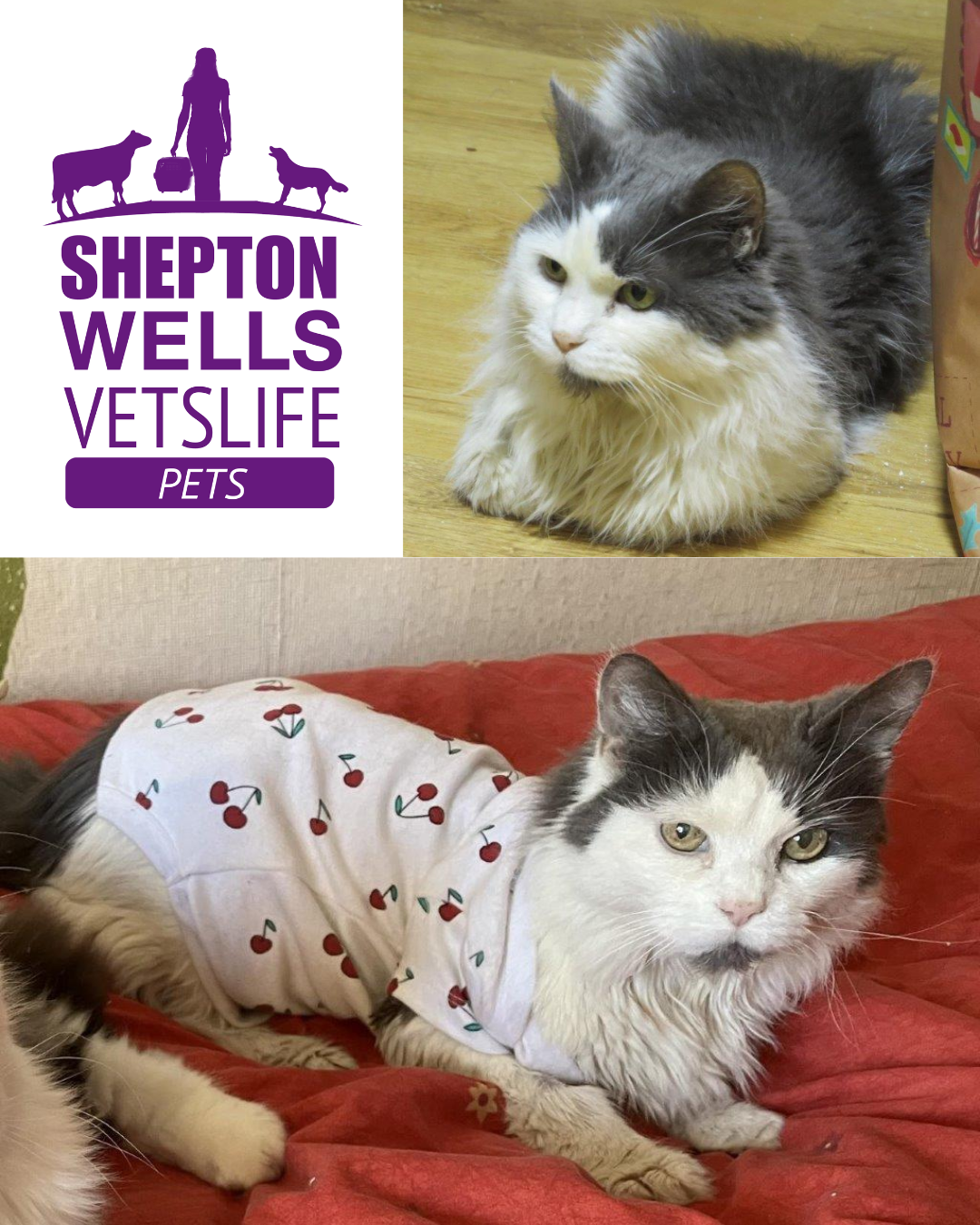
We also fitted Merry with a continuous glucose monitor, which looks like a small button stuck onto the skin over her ribcage. It was covered with a small dressing and further protected by her attractive cherry-patterned baby grow! This allowed me to monitor her glucose levels over 24-hour periods. The results showed that she was responding to the insulin injections, but rather than having a smooth curve over time, her glucose levels were fluctuating far too much and too rapidly.
We decided to try a different type of insulin, manufactured for humans rather than animals, which has a slow-release action. After gradually adjusting the dose again, Merry’s glucose levels became much better controlled and stayed within the range we wanted.
Since then, Merry has gained weight and is no longer drinking excessively. She is now living happily with her conditions, which is the best outcome we could hope for. I would like to commend her owner, whose dedication and unwavering care have seen Merry through a long and complicated journey of diagnosis and treatment.