From Sick to Celebrating: How Roco Made It to His 14th Birthday
As vets, we often put a lot of pressure on ourselves to find the correct diagnosis and treatment for our patients. The pressure is no different when treating a staff member’s pet and even greater when the owner is a family member!
I had to deal with such a situation back in March, when I received a message from my brother saying, “Can you call me? Roco is ill.”
Normally a big foodie, Roco is the type of dog who helps out at home by trying to clean the cutlery in the dishwasher, so for him to go off his food was unusual. In addition, he had been bringing up some foamy vomit during the day and was intermittently shaking – most likely because he felt sick. We see many animals brought into the practice for vomiting and/or diarrhoea, and the vast majority are suffering from some degree of gastrointestinal inflammation, which can be managed with medication
There was nothing immediately concerning on Roco’s examination, although he isn’t the sort of dog who lets you examine him without kicking up a fuss! He was given some supportive treatment, including an anti-sickness medication. Over the next couple of days, his appetite remained unchanged, so he was admitted to the vets for further investigations.
A blood test was performed with the results coming back as normal, and an abdominal ultrasound appeared generally unremarkable, although there was one area that seemed a little suspicious. Having spent the day on IV fluids, he perked up considerably, eating well before going home. However, the next day he was back.
I repeated the abdominal ultrasound, this time more convinced that the previously suspicious area was significant. It corresponded to the region where the stomach empties into the small intestine, known as the pylorus. It’s a tricky area to visualise on ultrasound, but it looked as though some foreign object might have been lodged there. An X-ray was also performed, but many foreign objects don’t show up on radiographs and Roco’s looked normal.
Often, if an object is causing a blockage or obstruction, the animal will persistently vomit despite treatment. However, Roco hadn’t vomited for a couple of days, which didn’t quite fit. Nevertheless, the area in question could be inspected further by passing a camera into the stomach, a technique known as endoscopy (more specifically, gastroscopy).
Roco was anaesthetised, and the camera was passed down his oesophagus into his stomach and on to the pylorus. This confirmed that something was lodged between the stomach and small intestine that should not have been there, though it was impossible to identify what it was. We tried grasping it with instruments to dislodge and remove it via the mouth, but it wouldn’t budge.
After speaking to Roco’s owner, my brother, we proceeded to surgery, as this was the only way to fully access the area and remove the object. During surgery, and after some manipulation, we managed to pass the object back into the stomach and remove it via a stomach incision before stitching up. Despite his advanced years, Roco recovered well. He stayed overnight following the surgery to be monitored by our night nurses and was sent home to recover the next day.
I knew he was feeling better when, as I was removing his IV line, he bit me – something he often tries to do whenever I have to check him over!
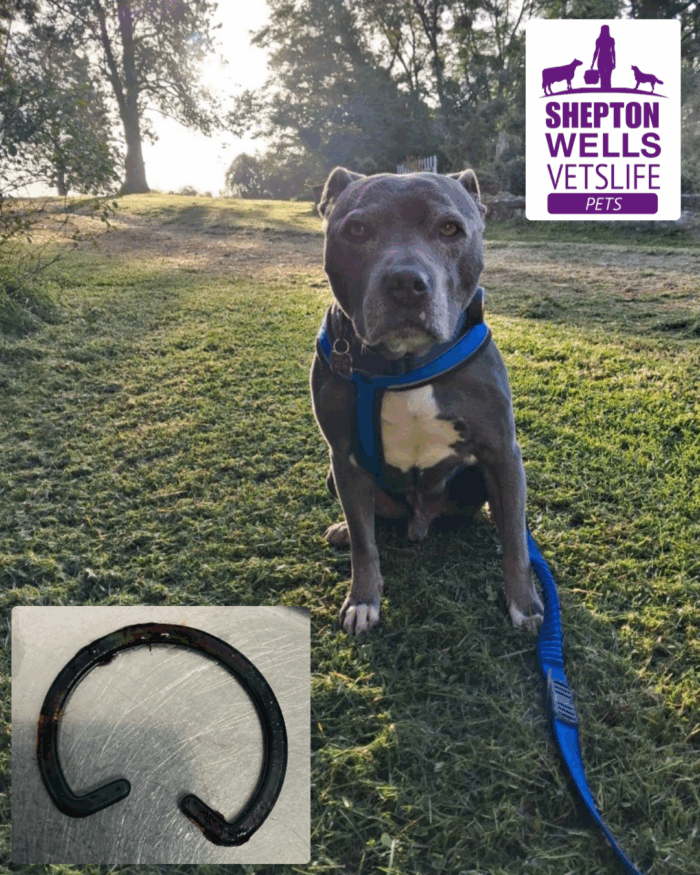
The object removed turned out to be a plastic clip that had become hooked halfway between the stomach and small intestine. It was hollow, which allowed fluid and food to pass through – explaining the lack of vomiting that would normally be expected.
Since his surgery, Roco has made a full recovery and turned 14 years old last month. He still doesn’t trust me though…

Author –