
Sting In The Tail On Spaniel’s Holiday
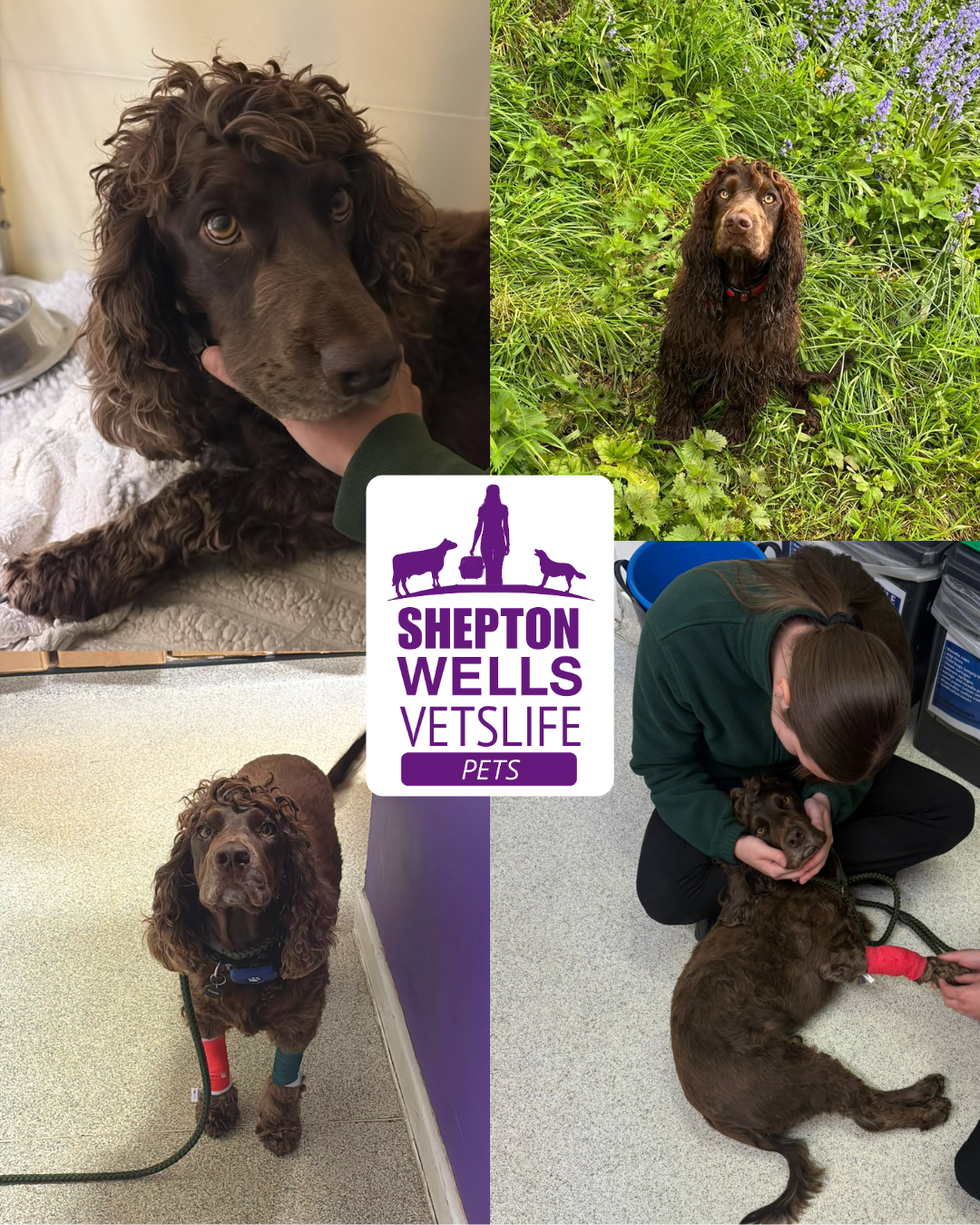
Bee stings are a common summer inconvenience for animals as well as humans whenever the sun comes out. A sting to the muzzle or paw can be a standard out-of-hours call to the weekend duty vet during the holiday season. This is often easily managed with antihistamine medication. However, very rarely, an allergic reaction to a sting, or a very large number of stings at once, can cause a serious condition similar to envenomation from a snake bite. This unlucky event happened to the unfortunate Cocker Spaniel, Cooper, and led to his hospitalisation at the practice for two nights.
Minding his own business on a walk, having barely settled into his weekend camping holiday in Devon, Cooper was just about to go to the toilet when he was set upon by a very large swarm of angry bees. Cooper and his owner had no choice but to run back to their campervan, being stung multiple times in the process. At one point, the swarm had descended on him so intensely that he looked as though he was wearing a coat of bees, with many concentrated on his left-hand side, stinging his belly and legs. By the time they returned from the walk, they were finally free of the bees, but both owner and dog were in shock after the traumatic ordeal. Unsurprisingly, Cooper was not himself that night and seemed very uncomfortable and unusually quiet. After advice from the duty vet over the phone, he was given antihistamine and pain relief tablets.
The next day, despite the medication, Cooper was still not right. He did not want to eat and his breathing was faster than normal. Most alarmingly, however, his urine appeared to be a very dark colour indeed. Cooper’s owners chose to cut their camping holiday short and made a Sunday morning visit to the practice, where the duty vets and nurses were working as usual to care for poorly patients. During his examination, many stingers were found embedded in Cooper’s skin and he was very sore. He produced a urine sample outside the practice which was almost black, resembling Coca-Cola.
Cooper’s blood and urine were tested that morning. The urine contained a pigment and protein called myoglobin, which is only present in such high levels when the body has experienced significant muscle trauma. In addition, his blood contained excessive amounts of creatine kinase (CK), an enzyme released into the bloodstream following muscle damage. The levels were so high that they were literally off the scale – a reaction similar to that seen following a venomous snake bite. When myoglobin and CK levels are this high, the kidneys are at risk of failure while trying to filter the blood. To protect Cooper’s kidneys, he needed to be admitted to the practice and placed on intravenous fluids to help flush these proteins from his system.
Cooper was hospitalised overnight and given paracetamol-based pain relief. He was limping and had a mild temperature, but had started to feel better and managed his first meal since the bee attack. The following morning, his urine was lighter in colour, indicating lower and more diluted levels of myoglobin, but his CK values were still too high for the laboratory machine to measure. This meant he would have to remain at the practice for at least a further 24 hours.
After another day, Cooper was beginning to return to his usual self. His temperature had settled and his limp had improved. Fortunately, his CK levels had also fallen and were now within the machine’s measurable range, although they remained above normal. It was a relief to see that his kidney parameters had not increased despite the abnormally high amounts of protein they had been required to process and filter. His urine had changed to a deep orange colour and he was eating normally, so at this stage he was allowed home to rest.
Returning to the practice each day to have his CK levels monitored, a pleasing trend emerged and, by the end of the week, they had finally returned to normal limits. Cooper could then be fully discharged.
We’re pleased to report that Cooper is feeling much better and is back to his usual happy self – while making sure to avoid any more swarms!
Cooper’s story shows that, in rare and extreme circumstances, bee swarms can cause far more harm to dogs than many people realise. Owners should therefore take extra care when walking near hives or areas where bees may be nesting.
“How lucky we are to have such a wonderful veterinary practice.
He was taken straight to Shepton Vets, where the support, compassion and expertise were outstanding. Cooper was extremely unwell, with enough venom in him to rival a snake bite, but the care provided by Greg Elliott‑Moustache, Cara Neal (slightly biased as she’s my daughter), and the entire team has been fantastic.
Their professionalism, kindness and dedication made all the difference during an incredibly frightening time.
Thank you, Shepton Vets, for everything you’ve done for Cooper.”
– Mr Neal(Cooper’s Owner)