Dotty’s High-Flying Mishap Has a Happy Ending
The adventurous young cat, Dotty, has made a full recovery after an unfortunate fall from an upstairs window – thanks to some careful surgery and four tiny pieces of metal.
At just 11 months old, Dotty is at an age when exploring the world is firmly on the agenda. Unfortunately for this young female neutered cat, one of her adventures took an unexpected turn when she was playing around an upper-floor window and fell out.
Dotty was soon brought into the practice by her understandably concerned owner. She was lame on her left hind leg and, on examination, it was clear that she was far from happy. Given the nature of the fall, there was concern that she could have injured either her limb, her pelvis, or both. X-rays were therefore advised to get a clear picture of what had happened.
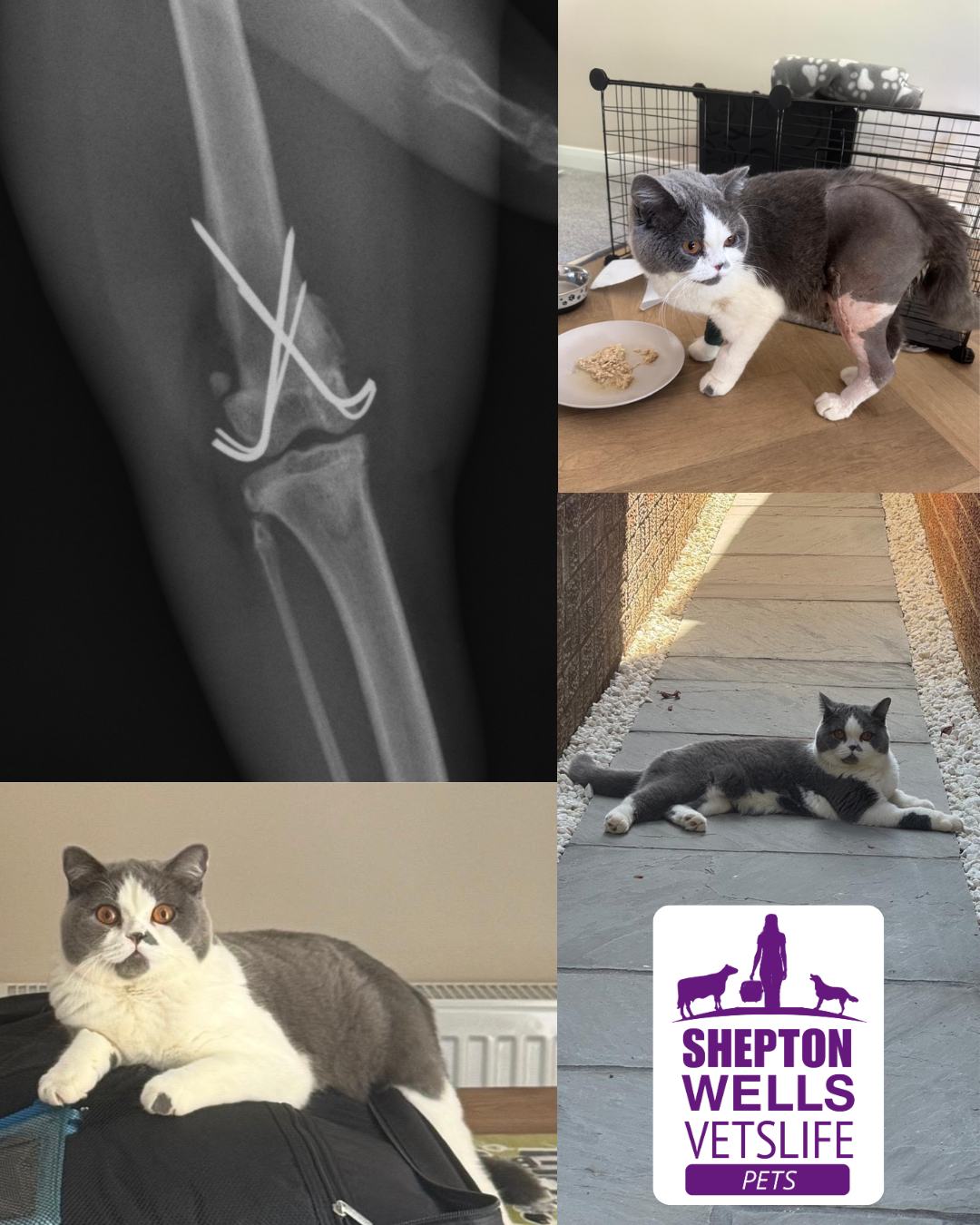
Dotty was anaesthetised and radiographs were taken. There was some good news: thankfully, her pelvis was completely fine. However, the X-rays revealed that the end of her left femur – the thigh bone – had suffered a fracture.
The fracture was what is known as a distal femoral physeal fracture. In young animals such as Dotty, the bones are still growing and contain soft areas known as growth plates. In this type of injury, the condyles – the rounded lower part of the femur that forms the knee joint – become displaced because the growth plate is considerably softer and more vulnerable than the surrounding mature bone.
These fractures need to be treated as urgently as possible as damage to a growth plate can potentially result in abnormal bone growth, which could cause problems with the limb in later life. With this in mind, Dotty’s surgery was scheduled for early the following morning.
The procedure performed was a cross-pin surgery. This involves carefully realigning the fractured bone before placing metal surgical pins across the fracture in a crossed fashion. The pins hold everything securely in the correct position while the bone heals. Thankfully for Dotty the surgical technique worked well, with four wires being placed and the fracture seeming very stable.
Afterwards, Dotty spent a short period in the hospital receiving pain relief and being closely monitored before she was able to return home. But while the operation was over, the hard work was certainly not finished.
Dotty’s owner was given an exercise and rehabilitation plan – and was faced with perhaps the most challenging part of the whole process: convincing an energetic 11-month-old cat that she was not, in fact, fully recovered.
As anyone who has ever tried to restrict a young cat will appreciate, explaining the concept of “rest” to an inquisitive feline is no easy task.
Dotty’s recovery plan involved periods of cage rest, gradually progressing to periods of rest within a small room. After around four to five weeks, it was time to find out how things were progressing.
Dotty popped into our Wells practice one day for another set of X-rays. The results were excellent. The fracture had remained stable and, even better, there were clear signs that it had healed well.
Although Dotty still had a mild limp, this was not unexpected given that her exercise had been deliberately restricted during her recovery. With the fracture looking strong and stable, she was allowed to gradually increase her activity.
Her freedom was extended to the entire house, eventually allowing her back upstairs – although with one important rule: no more investigating the windows!
Another four weeks passed, and we received a very welcome update. Dotty had continued to improve and was now back to normal.
From a rather frightening fall to a successful operation and a carefully managed recovery, Dotty’s story is a reminder of just how resilient young animals can be – and how important prompt veterinary assessment can be following an accident.
Today, Dotty is back to doing what cats do best: exploring, playing and getting on with life. All thanks to four very well-positioned little bits of metal and dedicated care from her loving owners.

Author –
Martin Law
BVSc BSAVA PGCertSAS MRCVS
Veterinary Surgeon
Small Animal Director