One step at a time: Angus’ story
Sometimes the smallest mistake can lead to a long journey of recovery. For Angus, one misjudged jump over a baby gate left him completely unable to stand, with a serious injury to his hind legs and an uncertain road ahead.
Angus had become trapped over a baby gate while the owner was out for two hours, and once freed he was lying on his side and completely unable to get to his feet. He appeared to have lost the use of his left hind leg and was quiet and subdued when he arrived at our out-of-hours service.
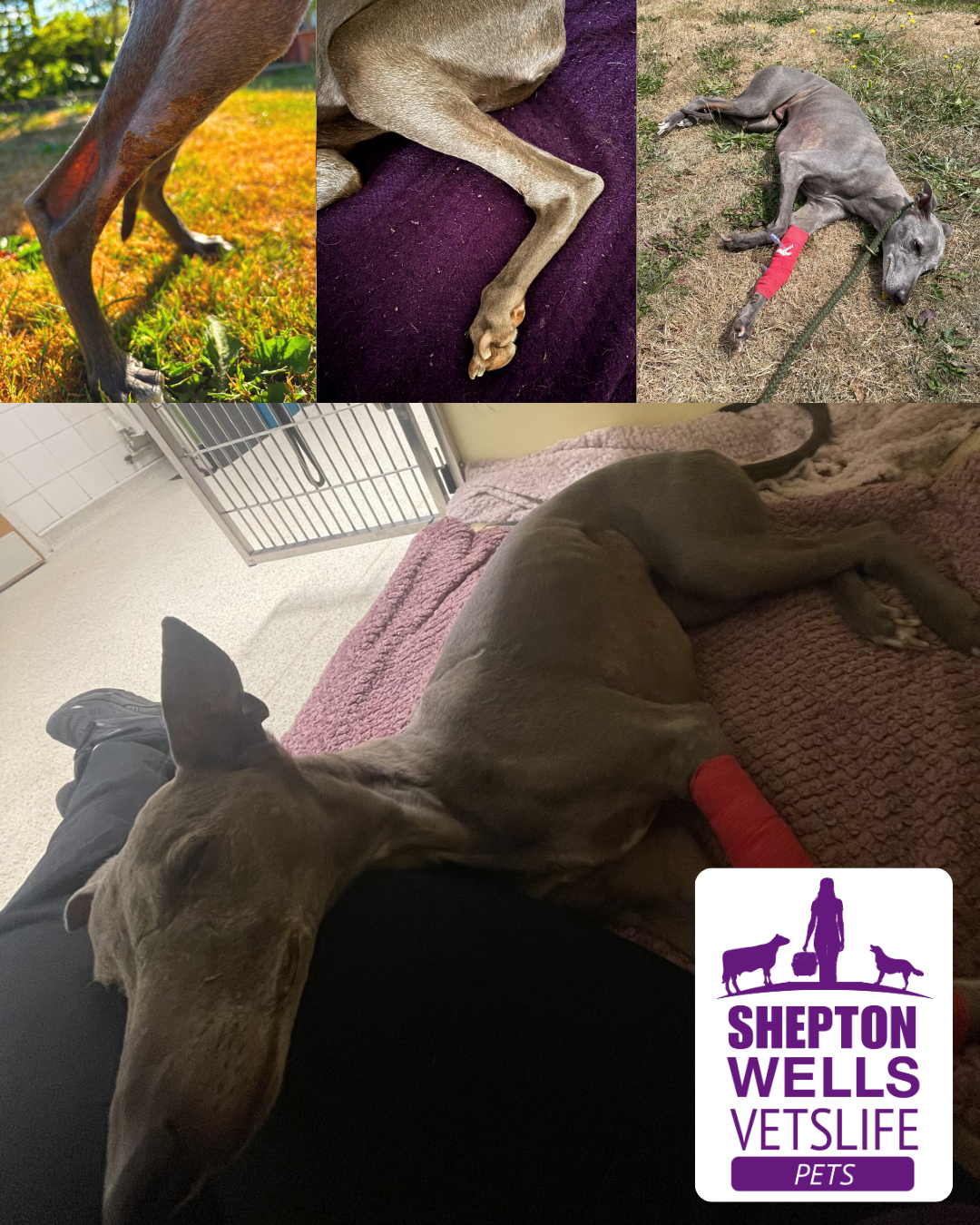
Examination revealed significant bruising and swelling to his left thigh, with clear marks where the leg had been compressed against the gate. There was also a deep wound on the outside of the leg extending through to the underlying tissues, while his right hind leg had suffered a large graze.
Thankfully, X-rays showed no fractures or other obvious bone injuries. However, Angus had no deep pain sensation in his left hind leg, suggesting that the nerves supplying the limb had been significantly affected. At this stage, there was no way of knowing how much function he would eventually regain, or whether he would be able to stand and walk normally again.
Angus was anaesthetised so that his deep wound could be thoroughly cleaned and explored. Fortunately, the underlying tendons were intact and the wound could be carefully repaired. He was then admitted to hospital for intravenous fluids, antibiotics and strong pain relief while his condition was closely monitored.
The following days proved challenging. Angus’s hind legs became extremely swollen and he developed frequent regurgitation and stopped eating. Blood tests showed changes affecting his liver and kidneys, alongside low blood protein levels. Fortunately, an ultrasound scan showed no evidence of internal bleeding, and these changes were thought to be associated with the significant trauma and the body’s response to his injuries.
Angus needed intensive nursing care around the clock. His medications were carefully adjusted to control his pain and nausea while reducing the strain on his liver and kidneys. Intravenous antibiotics were started, and our nurses spent lots of time massaging his legs and carrying out gentle rehabilitation to reduce the swelling and encourage movement.
Gradually, small changes began to appear.
The swelling in Angus’s legs started to reduce and he became much brighter and more aware of his surroundings. Most importantly, deep pain sensation returned to his left hind leg. Although he was still unable to stand independently, he was beginning to move both hind legs more purposefully.
As his strength improved, Angus began rehabilitation with the support of a sling. At first, simply standing was a huge milestone. He then began taking a few supported steps, slowly building his strength and coordination. His appetite returned, the regurgitation settled and his blood results began to improve.
With every day of rehabilitation, Angus became stronger. He progressed from needing support to stand, to walking with the sling, and eventually to taking steps without assistance.
After seven days of intensive hospital care, Angus was walking independently.
Angus was discharged home with medication and a rehabilitation plan to continue building his strength and coordination. Although there was still work to do, he had overcome the biggest hurdle in his recovery: getting back on his feet.
Angus’s journey is a wonderful reminder that recovery doesn’t always happen overnight. Sometimes it is made up of a series of tiny victories: the return of sensation, the first movement of a leg, standing for the first time, and finally taking those first independent steps.
What started with one unfortunate misjudgement became a remarkable journey of determination and recovery. We were delighted to see Angus walk out of the practice after his week-long stay, back on all four legs and heading home to continue his rehabilitation with his family.

Author –
Ella Pears
BVSc MRCVS
Veterinary Surgeon