Pins, Patience and Puppy Energy: Goose’s Road to Recovery
At just four-and-a-half months old, Goose was already impossible to forget. The American bulldog cross Staffordshire bull terrier had been coming to the practice since he was a tiny puppy, visiting for his vaccinations and routine checks. From the beginning, he had been the same way every time he bounded through the door – bonkers, affectionate and wonderfully well behaved.
So when Goose’s owners called the emergency service after a rough play session with another dog left him suddenly lame on his left back leg, concern was immediate. Despite the injury, Goose was otherwise bright, happy and comfortable at home, so advice was given for him to rest overnight before being seen first thing the following morning.
When Goose arrived at the clinic the next day, he greeted everyone exactly as expected: tail wagging, eager for attention and still desperate to make friends with anyone nearby. But it was obvious he was sore. Given his age and the severity of the lameness, veterinary surgeon Ella recommended X-rays straight away.
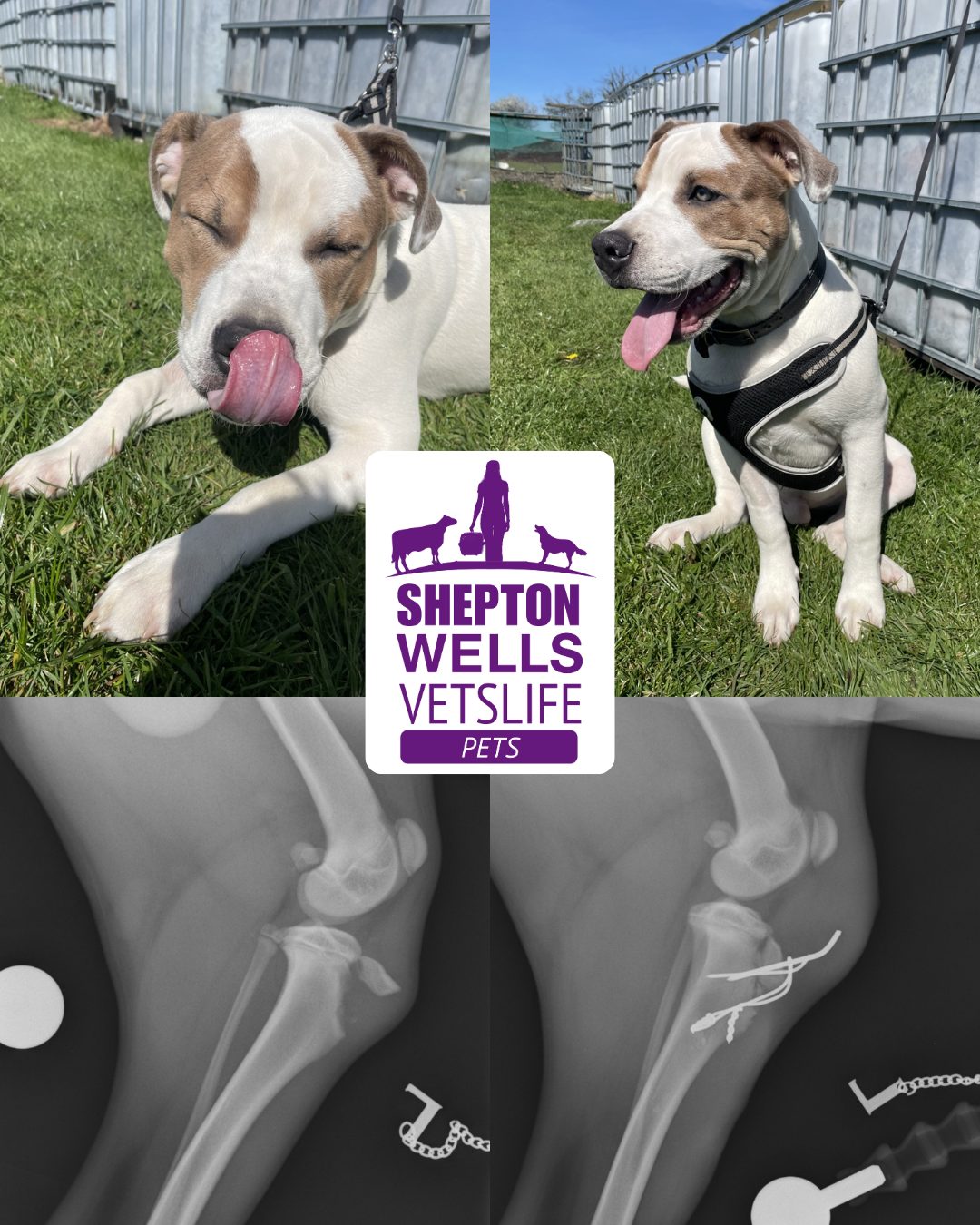
There was concern that Goose had suffered an orthopaedic injury, and the scans quickly confirmed those fears. Goose had sustained a tibial crest avulsion fracture – a fracture to the knee that can occur in young puppies.
In young dogs, parts of the bone are still soft and developing. In Goose’s case, the injury involved the section of growing bone where the patella tendon attaches to the shin bone. During the rough play, a sudden and powerful contraction of Goose’s quadriceps muscle had literally pulled that piece of bone away. For a muscular, energetic puppy like Goose, the combination of strength and immature bone had proved too much.
Without treatment, the consequences could have been severe. The fragment of bone could have detached completely, leaving Goose unable to properly extend his leg because the muscle would no longer be connected to the shin bone. Not only would it have been extremely painful, but it could also have permanently affected his mobility. Surgery was the only real option.
The challenge for this type of surgery is always creating a repair strong enough to withstand the forces generated by such an enthusiastic young dog. To do this, pins and orthopaedic wire were used to create a system known as a pin and tension band.
While the technique sounds complex, the principle is surprisingly elegant. The tension band converts the pulling force of the muscle into a compressive force, helping press the fractured bone back together every time the leg moves. Simple, but incredibly effective.
Goose underwent surgery successfully and, almost immediately afterwards, seemed far more comfortable. The fracture had been repaired and stabilised. Now came what everyone suspected would be the hardest part of the entire process: keeping Goose still.
Strict rest and controlled exercise were essential to allow the repaired bone to heal properly. Unfortunately, explaining this to an exuberantly friendly puppy with endless enthusiasm for life proved somewhat difficult. Goose wanted to play with everyone and everything.
To their enormous credit, his owners did an outstanding job managing him during recovery. For weeks they carefully controlled his exercise, monitored his activity and followed every instruction. But three weeks into recovery came a moment that Goose had been waiting for. When there was momentary slack on his lead Goose suddenly pulled hard and shot off before anyone could stop him. Although he quickly returned a few hours later his owners noted a swelling over his operated knee and at the first opportunity they brought him back to the clinic.
Thankfully, despite the swelling, Goose remained bright, friendly and was still walking well. The swelling felt like a fluid capsule over the region where the pins were – the body effectively trying to protect the site. Repeat X-rays brought reassuring news: the fracture itself was healing nicely. However, the sudden force had caused the surgical pins to begin working loose.
The team explained that, over time, the pins would inevitably lose their support if left in place. Fortunately, because Goose was so young, his healing was progressing rapidly. Rather than rushing into immediate intervention, it was decided to reassess him the following week.
When Goose returned, he was anaesthetised this time for further X-rays. The images confirmed excellent ongoing healing, and with the fracture now stable enough, the loose pins were removed. At last, Goose could begin the long road back to normal exercise.
Gradually, week by week, his activity levels were increased as his strength and confidence returned. Unsurprisingly, Goose excelled at the “more exercise” part of rehabilitation. The difficult bit remained convincing him not to overdo it.
Now, around six weeks later, Goose’s owner reports he is fully back to his old self. Aside from the patch of shaved fur on his leg – the final visible reminder of his ordeal – nobody would know he had suffered such a significant injury.
Goose’s recovery has been a brilliant outcome and a reminder of how resilient young dogs can be with the right treatment and care. But special congratulations go to Goose’s owners. Managing the recovery of a powerful, energetic and relentlessly friendly puppy was no easy task, and their dedication played a huge role in getting Goose back on all four paws.